


Optimizing projects
Strategy for project optimization
We know today that PDCA is a standard that has taken the lead in every project ever made, even without consciously thinking about it. Deming reached the most global aspect of project management and created a strategic way of understanding how projects are managed globally.
PDCA stands for Plan - Do - Check - Act.
It's essentially the main roadmap for what happens when a project is launched.
First, you PLAN.
This involves developing every detail, setting objectives, identifying stakeholders, establishing governance, setting a timeline, determining involved resources, budgeting, identifying risks, and developing mitigation plans.
Then you DO.
This is the execution phase, where you see the project taking shape step by step. You carefully manage meetings, take notes, act according to your plan, monitor the budget and timeline, create graphics to visualize progress, and keep people involved. You also likely create a RACI chart to ensure all stakeholders are well-managed and informed. In a way, you watch the project grow and intervene when necessary.
CHECK is the monitoring and controlling phase.
You track performance throughout the project and review it to determine if the project is complete or if it needs improvement, either globally or in specific parts. Making the process agile addresses potential issues because it becomes iterative and incremental. You have a Minimum Viable Product (MVP) ready and delivered, so even if the project is not entirely finished, client satisfaction indicates success. If adjustments are needed, you know you can already deliver some value and update it later. The product is working, and that's what matters, but you keep the project on track regardless of what happens next because a Service Level Agreement (SLA) is probably involved too.
Finally, there is the ACT phase.
Where you take actions to reinforce the parts of the project that did not go as planned. With the data gathered throughout the project's life, you can easily identify what didn't work and why. This way, you can address those issues before they arise in the next project you work on.
And the cycle continues.

But then, knowing this, how can we improve the PDCA project process theory ?
We know that PDCA is the simplest and most effective way of visualizing a project today. However, despite this, many projects still seem to be delayed in every company.
So, why is this happening ? Where does the issue come from ? And how can we address it efficiently ?
First we have to find the root cause :
- Lack of proper planning
- Lack of communication
- Poor risk management
- Inefictive monitoring and control
- Lack of experienced staffing
- Process rigidity
- Ineficient team leader
Those are exemples, but we can also search using another method, Kaizen
It will allow us to clearly identify problems and standardized a solution to apply for this specific problem.
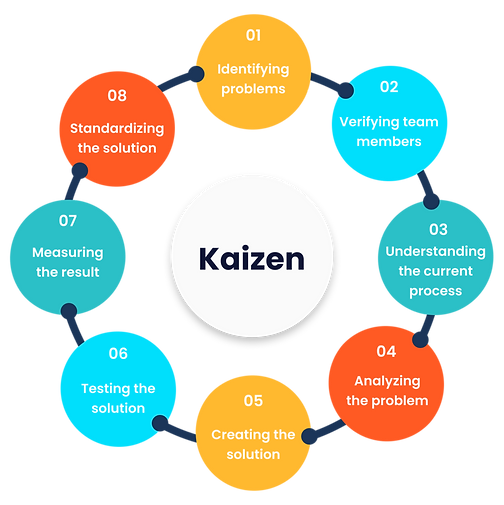
Now that we have identified the issues, we can look at the solutions :
- Planning : Plan according to your knowledge. Add 10% to 20% extra time for any part you are unsure about. Also, review old projects to see how each part was managed, how long specific parts took, and the length of any delays.
- Communication : Set regular and efficient meetings. Keep them short if possible, but hold them frequently enough to track the project's progress. It's better to check twice than not at all.
- Risk : Be very cautious about risks. Consult subject experts if you are unsure. Ensure staffing specifically for risk management. Review risks individually and globally at the beginning and end of the study.
- Control : Use the right tools to help you monitor the project. Set KPIs that will guide you, and follow them weekly to get a global view of the project's progress. If you find mistakes or inefficiencies, closely monitor that specific part of the project.
- Experience : Experience is an important skill. If you have to work on a difficult project, ask for help. Seniors should closely follow the work of new employees.
- Process : If tasks take too much time, if validations are needed but delayed, causing the project to exceed its schedule, then question the process. Remember, there is no perfect process, and everything can always evolve into something better.
- Leader : The person in charge must be aware of what they are doing. The team can be very efficient, but without direction, the project can crash. It's important for a leader to be positive, present, review every part, and question what exists.
If you do all this and are careful enough, then your project will be successful.
Find a way to improve visuals and communicate it to the team, they can also interact and give advice, it will create sinergie


